


43.5% of skin gamblers started as teenagers. 3 in 4 parents had no idea.
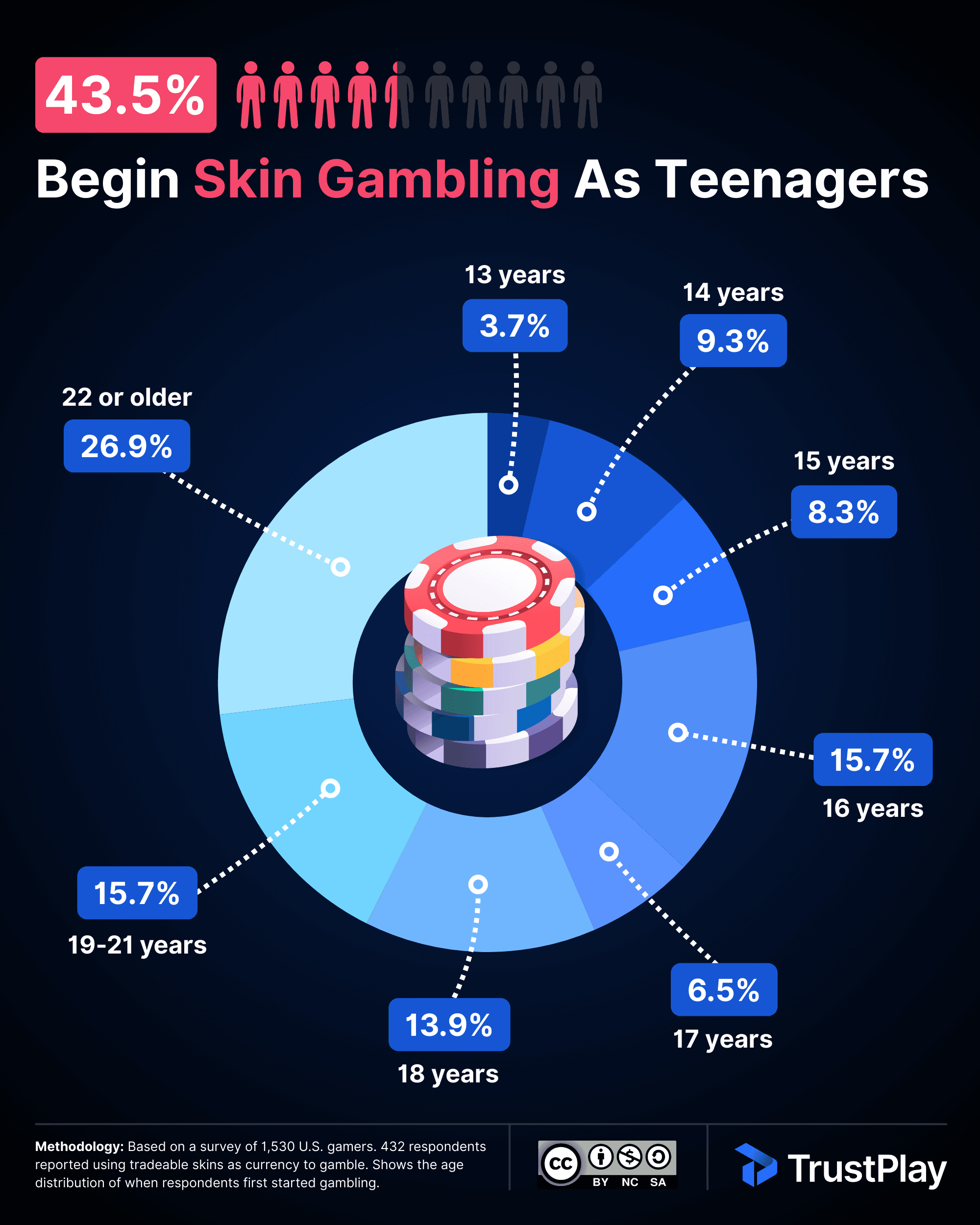
Among gamers who have gambled their skins on third-party websites, 43.5% started before they turned 18. The most common starting age was 16, though some began as young as 13. When asked if their parents ever discovered the gambling, 76.1% said no. Half say their parents still don't know to this day.
We surveyed 1,530 gamers about their experiences with skin gambling—websites where players deposit in-game items from games like Counter-Strike 2 and Dota 2 to bet on casino-style games, esports matches, or case openings.
What we found is an industry that mostly sidesteps gambling regulations. Teenagers can deposit valuable skins without any age checks - but when they win and try to withdraw, suddenly they need a government ID they can't provide.
Key Findings
- 47.1% of gamers who own tradeable skins have used them to gamble on third-party websites
- 43.5% of skin gamblers started while under 18 years old
- 79.4% report behaviors recognized as clinical markers of problem gambling
- 72.2% lost money, with average losses exceeding $1,100
- 76.1% of parents were unaware their child was gambling
- 9.0% lost over $5,000, with some reporting losses exceeding $10,000
The Scale of Skin Gambling
By 2016, skin gambling had grown into a $7.4 billion industry. That July, after a wave of scandals—site owners caught rigging wins for streamers, YouTubers exposed for secretly owning the sites they promoted—Valve issued cease-and-desist letters to 23 gambling sites. Most ignored them.
Nine years later, no updated market figures exist. These sites operate across jurisdictions, accept crypto and skins instead of credit cards, and don't publish revenue—regulators have no way to track them. But the underlying skin economy has only grown. Counter-Strike 2 skins alone are now worth over $5 billion. Dota 2, Rust, and Team Fortress 2 add billions more.
The gambling never stopped. A 2025 UK government review found over 50 active skin gambling sites still operating, with 6.9 million visits in February alone. Some drew more traffic than Betway or Betfred.

Our survey tells a similar story. Of 918 gamers who own tradeable skins, nearly half (47.1%) have used them on third-party gambling sites—casino games, case openings, and esports betting.
A Google search for "CS2 gambling" returns dozens of active sites, many with paid advertising. Unlike traditional online casinos that require credit cards and identity verification, these sites only need a Steam account—which millions of teenagers already have.
How Teenagers Access These Sites
In our survey, respondents often mentioned learning about skin gambling from YouTube and Twitch streamers. Until recently, young gamers also saw gambling site logos on professional players' jerseys during major esports tournaments. Valve only banned these tournament sponsorships in 2025.
"Everyone played CS, and everyone gambled when I was young (13-14 years old). All we talked about was betting skins on cs go lounge for esports games."
"I followed a streamer who did a lot of box openings, and he had a gambling website sponsor. He eventually also did online gambling on these websites on the streams. I ended up trying these websites because of this."
"I played some time on sites with gambling, like CSGOLounge, in 2014. This was my first touch with gambling." —Survey respondent who started at age 14
A 2024 investigation by Barron's found that 120 of Twitch's most-watched Counter-Strike streamers were sponsored by skin gambling sites, with some receiving offers of up to $200,000 per month.
These pathways lead to real harm. Dr. Heather Wardle, a gambling researcher at the University of Glasgow, told TrustPlay in response to our survey that 'skin betting should be viewed as a high risk gambling activity'—comparable in risk to online slots or casino games.
'It is even more risky if children under the age of 18 are engaging in something that rightfully should be age-gated.' Her prior research found that 39% of children who bet on skins in the past month had also gambled on other activities, with higher rates of problem gambling than non-skin bettors (23% vs. 8%).
A 2019 UK study found that 11-to-14-year-olds were more than twice as likely to gamble with skins as 22-to-24-year-olds—and that 67% of young people considered it normal for their peers to do so.
The Deposit Trap
Depositing is easy. Withdrawing isn't.
Most sites let anyone deposit skins or cash without verification. But to withdraw winnings, they require government ID.
When a teen deposits skins, the gambling site doesn’t ask questions. But if they win and try to withdraw, the site asks for age verification that the user can’t provide. The winnings are trapped, so the user keeps gambling. If the site discovers they’re underage, they can ban the account and keep everything. Most terms of service allow exactly this.
"I discovered a site where you could deposit skins, get credit for them, and bet on a simulated roulette machine. I was doing it for a few weeks, but I always ended up losing my money because I made bigger and bigger bets wanting to win back my losses."
YouTuber Coffeezilla described it in his December 2024 investigation: "With Counter-Strike, there is an underage gateway to all of this because all you need is $2.50 to get your first skin through Valve, and you don't even need to show ID. Even worse is when you go from the game to the Casinos, which are hosted on third-party websites, most don't ID the players either and if they do, it's after you have gambled thousands of dollars."
Financial Losses

72.2% of skin gamblers lost money, with average losses exceeding $1,100. Most lost under $500, but 9% lost over $5,000—some reporting losses of $10,000 or more. Only 14.8% reported net profits.
"It was one of the gateways to the gambling addiction that I am currently struggling with. I lost incredible amounts of money and time, went into big debt, and still haven't fully recovered." - Respondent who started at 14 and lost over $5,000
"My biggest win was 1800 dollars, and I lost my salary once through it while trying to recover losses. It was a very painful period of my life."
"I have lost a lot of money that was my mother's, and I stole it, so I feel bad now, and she never forgave me for it."
"I have won 5000 USD and didn't cash out. I wanted more, and it was all gone. I ended up taking loans trying to recover the money I lost, and ended up in debt I can't handle."
The accessibility is what makes it dangerous. Traditional gambling requires credit cards, bank accounts, and age verification. Skin gambling requires none of that—just a Steam account.
Clinical Markers of Problem Gambling

We asked respondents about behaviors recognized by clinical screening tools for problem gambling. 79.4% reported experiencing at least one:
- 47.7% tried to win back losses by gambling more ("chasing losses")
- 43.0% felt guilty or anxious about their gambling
- 30.8% needed to gamble with more valuable skins to get the same excitement
- 21.5% felt restless or irritable when trying to cut down or stop
- 14.0% borrowed money or sold possessions to fund gambling
- 14.0% lied to family or friends about gambling activity
In a traditional casino, exhibiting these behaviors would trigger responsible gambling interventions. On skin gambling sites, there are no such safeguards.
"I realized it's not just for fun, and it's starting to make me chase my losses. As soon as I was in plus, I deleted all my accounts on gambling websites."
"It started as something casual. I was trading and betting skins to make the game more exciting. Once, I won a really valuable skin, and it felt amazing, like a big win in a real casino. But later, I lost even more trying to chase that same feeling."
Parents in the Dark — And Those Who Know Often Don't Understand
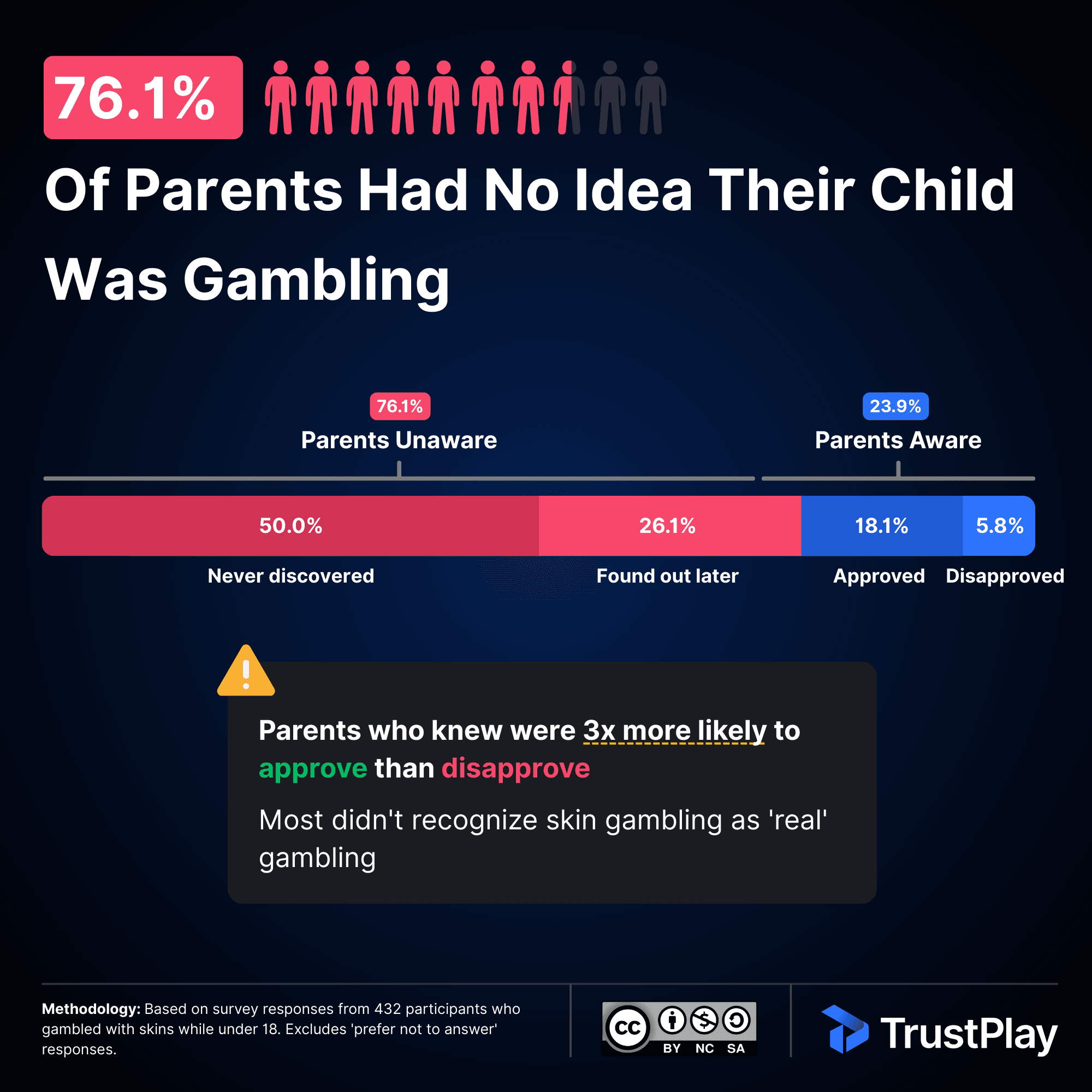
Among respondents who gambled as minors, 76.1% say their parents were unaware at the time, with half never finding out at all.
But more striking is what happens when parents do know. Of the 23.9% whose parents were aware, the overwhelming majority (75.7%) approved.
This suggests many parents don't recognize skin gambling as real gambling. When the activity looks like a video game and uses virtual items instead of cash, the danger isn't obvious. Parents may see their child "playing Counter-Strike" without realizing money is changing hands on offshore casino sites.
"My mom didn't know for years," one respondent wrote. "When she found out, she didn't really care because she didn't understand what it was."
The Regulatory Gap
The skin gambling ecosystem thrives because transactions are hard to regulate and trace. Sites accept skins and cryptocurrency instead of traditional payment methods, making it difficult for authorities to track who is gambling and enforce age restrictions.
Some larger sites obtain gambling licenses from jurisdictions such as Curaçao, where regulations are minimal, and enforcement is weak. Many smaller sites operate with no license at all. Many sites skip the checks that legitimate casinos must follow: strict age verification before accepting deposits, identity checks, deposit limits, and monitoring for problem gambling.
When a traditional online casino accepts credit cards or bank transfers, payment processors can verify age and block minors. When a site accepts skins, there's no safety net. All it takes is a Steam account that any teenager can create.
Valve's Role
Valve takes a 15% transaction fee on every skin sold through its marketplace. The gambling ecosystem drives skin demand, which drives trading volume, which generates revenue.
"A lot of the games with tradeable skins are from Valve, so I think they have a huge part in this being possible at all." —Survey respondent
The 2025 ban on tournament sponsorships addresses visibility at the professional level—but it doesn't prevent individual players, particularly minors, from accessing these sites.
Who's Responsible and What Can Be Done
The diffusion of responsibility helps explain why the problem persists. Gaming companies say they can't control third-party sites. Gambling sites say they're not "real gambling." Parents don't know it's happening. Regulators struggle with jurisdictional issues.

When asked who bears most responsibility for preventing underage skin gambling, respondents pointed overwhelmingly at game developers like Valve and Epic (30.7%), followed by parents (21.2%), the gambling sites themselves (19.5%), government regulators (14.1%), and players (13.7%). Less than 1% said it shouldn't be prevented at all.
The message is clear: those who've experienced skin gambling firsthand believe the companies profiting from the skin economy should be doing more to protect minors.
Solutions exist. Age verification works for traditional gambling sites. Trading restrictions could prevent minors from accessing high-value economies. Deposit limits, self-exclusion tools, and responsible gambling features are legally required in regulated markets, but completely absent from skin gambling sites.
Meanwhile, teenagers deposit skins worth hundreds or thousands of dollars on sites designed to extract maximum engagement, show clinical markers of addiction at a rate of 79.4%, and lose money 72.2% of the time.
Conclusion
47.1% of gamers who own skins have gambled with them. 43.5% started while underage. 79.4% show behaviors recognized as markers of problem gambling. 76.1% of parents never knew.
Valve sent cease-and-desist letters in 2016 and banned tournament sponsorships in 2025. The sites are still operating.
The next generation of gamers is learning that the skins they're collecting can be turned into casino chips. Some will lose money they can't afford. Others will develop gambling habits that follow them into adulthood. Some already have.
Methodology
We surveyed 1,530 gamers in November 2025. Participants were first asked whether they owned or had owned tradeable in-game skins (CS2, Dota 2, Rust, TF2, or similar games). Of the 1,530 total respondents, 918 (60%) answered yes. These 918 skin owners were then asked detailed questions about their experiences with third-party gambling sites.
Participants were recruited through English-language research panels, with the majority based in the United States. The survey took approximately 5 minutes and was completely anonymous.
Age distribution: Under 18 (4%), 18–24 (27%), 25–34 (47%), 35–44 (19%), 45+ (3%)
Margin of error: ±3.3% at 95% confidence for skin owner subsample (n=918)
Key measures: Gambling participation, age when started, financial outcomes, problem gambling behaviors (adapted from Problem Gambling Severity Index), parental awareness, attribution of responsibility.
Resources
If you or someone you know struggles with gambling:
US: National Problem Gambling Helpline: 1-800-522-4700
UK: National Gambling Helpline: 0808 8020 133
International: BeGambleAware.org
Data is correct as of November 2025.
