We surveyed 1,847 gamers to understand how third-party marketplace scams actually happen. The results reveal a multi-billion-dollar epidemic hiding in plain sight.
What We Did
We surveyed 1,847 gamers across the United States about their experiences with third-party gaming marketplaces. On these sites where players buy, sell, and trade in-game items, skins, accounts, and currency outside official stores.
These marketplaces have exploded alongside gaming's growth. The CS2 skin market alone has surpassed $6 billion, while overall PC gaming microtransactions generated $24.4 billion in 2024. With 3.32 billion global gamers and minimal regulation, these platforms have become hunting grounds for sophisticated criminals.
Our survey targeted players of Counter-Strike 2, Dota 2, Rust, World of Warcraft, and other trading-focused games. The results paint a disturbing picture of normalized fraud and platform accountability gaps.
Key Findings
- 33.7% of third-party marketplace users have been scammed, losing an average of $409 per incident.
- Gamers under 18 face a 41.6% scam rate, nearly triple the 14.9% rate among players 45 and older.
- 75.5% of victims were fooled by professional-looking websites that mimicked legitimate marketplaces.
- Fake marketplace sites that never deliver items account for 38.5% of all scams, making them the most common type of fraud.
- 65.4% of scam victims noticed red flags before purchasing—but proceeded with transactions anyway.
- CS2 players face the highest scam rate at 38.7%, with average losses of $437 per incident.
One in Three Marketplace Users Gets Scammed
Of the 1,441 respondents who used third-party marketplaces, 33.7% reported losing money or items to scams. That's 486 victims in our sample alone—representing the experience of active marketplace participants rather than all gamers.
With Steam hosting 132 million monthly active users and millions more across other platforms regularly using third-party marketplaces, our survey suggests gaming marketplace fraud represents a multi-billion dollar problem affecting millions of victims annually.
This aligns with industry data. TransUnion reported that 10.9% of U.S. gaming transactions showed suspected digital fraud in 2023—the highest rate of any industry. The FBI's Internet Crime Complaint Center documented $16.6 billion in cybercrime losses in 2024, a 33% increase from 2023.
The Average Scam Costs $409
Among our 486 victims, losses ranged from under $50 to over $5,000. The median loss was $285, while the mean reached $409, pulled higher by victims who lost thousands.

CS2 players suffered the highest average losses at $437, followed by Dota 2 at $415 and Rust at $372. This correlates with market size. The CS2 economy is valued at $5-6 billion, making it the most lucrative target. MMO players averaged $295 in losses.
Professional Design Fools 3 in 4 Victims
When we asked scam victims what made them trust fraudulent sites, 75.5% said the professional-looking website convinced them it was legitimate—far more than positive reviews (63.5%), high Google rankings (48.1%), and deals too good to pass up (34.4%).

This reveals that scammers have successfully mimicked legitimate businesses. Modern fraud operations invest in professional web design, SSL certificates, fake customer reviews, and polished interfaces that rival real marketplaces.
34.4% admitted they knew the deal was "too good to be true" but proceeded anyway. There's a clear psychological pull of discounted items, especially among younger players.
How Gaming Marketplace Scams Actually Work
To understand what protection measures work, we first needed to understand how scams actually happen. We asked our 486 victims to identify which type of scam they experienced.
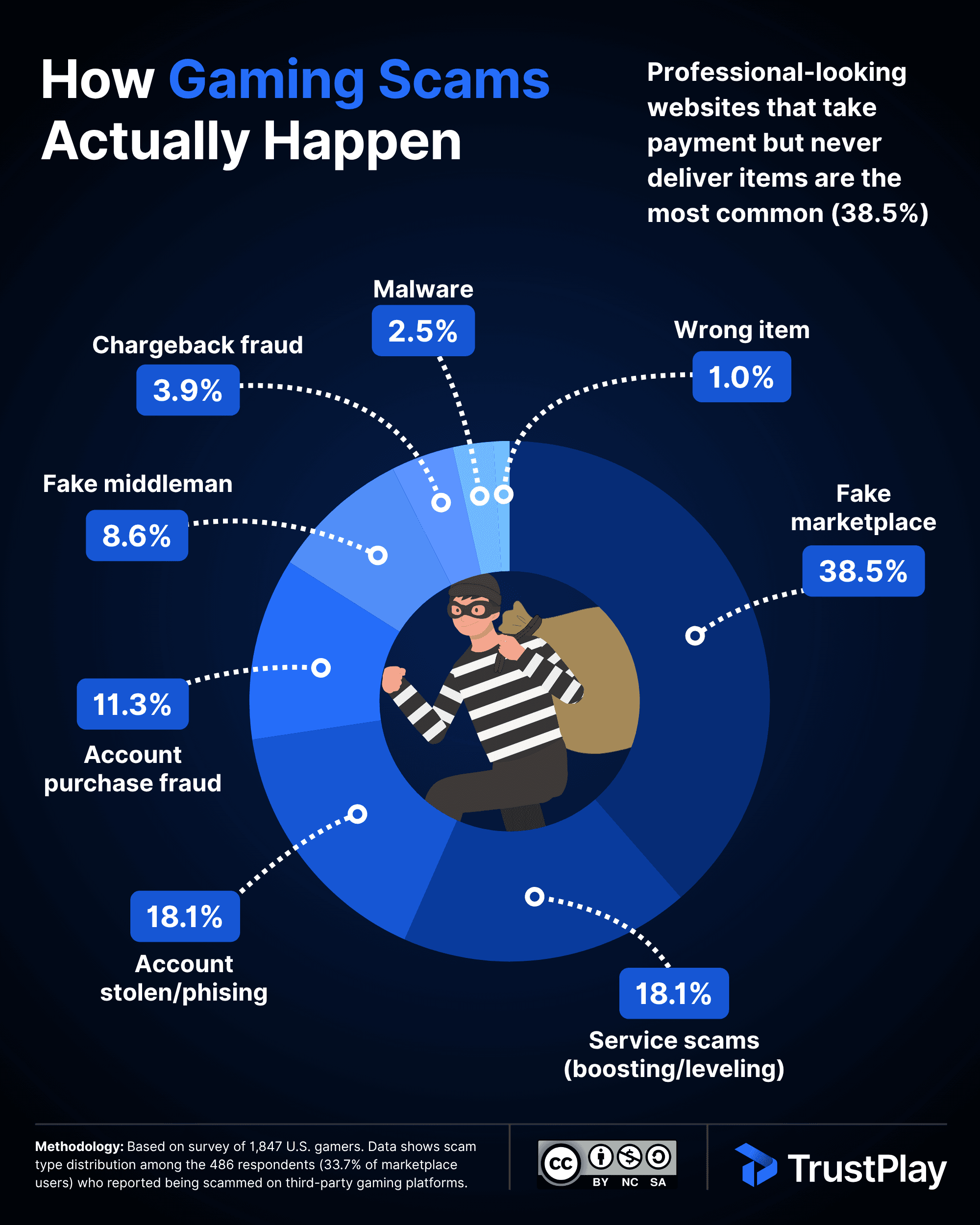
Fake marketplace sites dominated at 38.5%—professional-looking websites that take payment but never deliver items. These sites often rank high in Google searches and feature polished interfaces mimicking legitimate marketplaces.
Service scams represented 18.1% of cases—victims paid for rank boosting, account leveling, or coaching services that were never delivered. While individually lower in value (averaging just $95), these scams are common enough to represent the second-largest category.
Account compromise through phishing links and fake login pages affected 16.0% of victims. Once compromised, entire inventories can be drained within minutes, resulting in average losses of $485.
Account purchase fraud accounted for 11.3%—buyers received banned accounts, stolen accounts later reclaimed by their original owners, or accounts that didn't match descriptions.
Fake middleman services represented 8.6% but caused the highest average losses at $725, as they specifically target high-value trades where sellers and buyers seek "trusted" escrow.
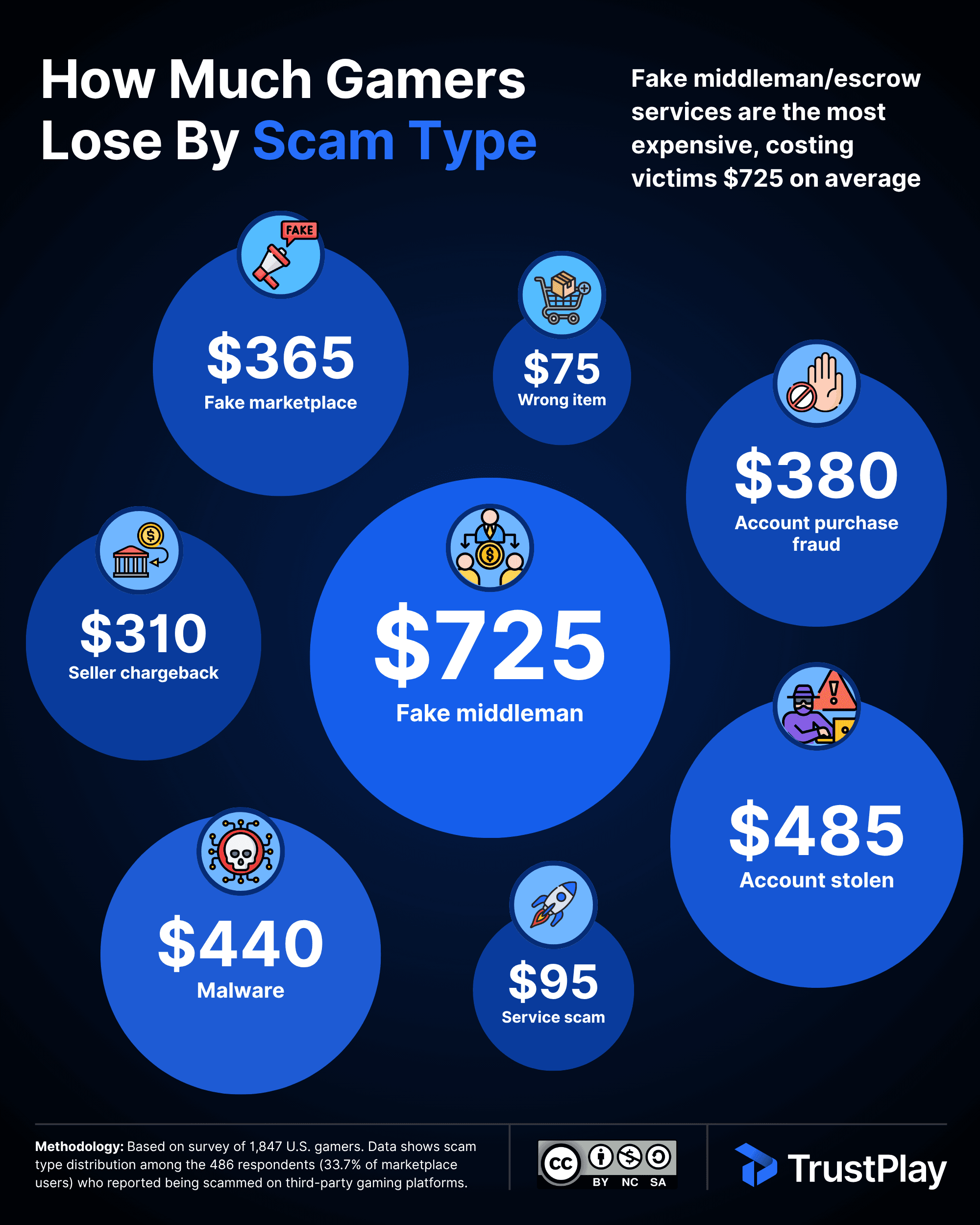
The fake middleman/escrow service is by far the most expensive scam type in our survey, costing victims $725 on average. Stolen accounts show an average loss of $485, with malware following at $440. Despite their prevalence, fake marketplaces result in $365 in financial losses on average.
Seller chargebacks ($310) and service scams, such as fake boosting and in-game currency ($95), are both common but cause less overall financial damage.
Two-Thirds Saw Red Flags But Clicked Anyway
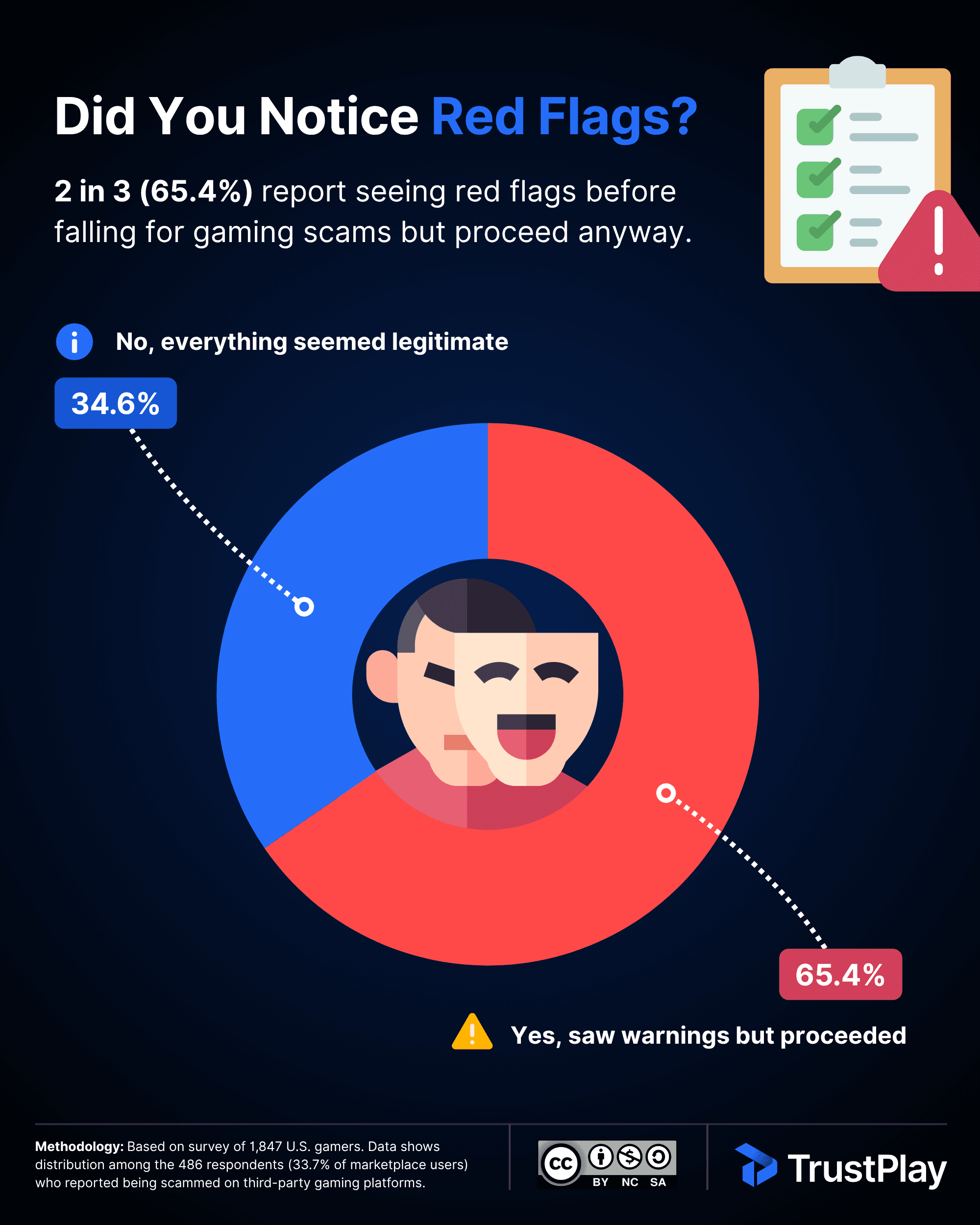
65.4% of scam victims reported noticing warning signs before completing transactions, but proceeded anyway.
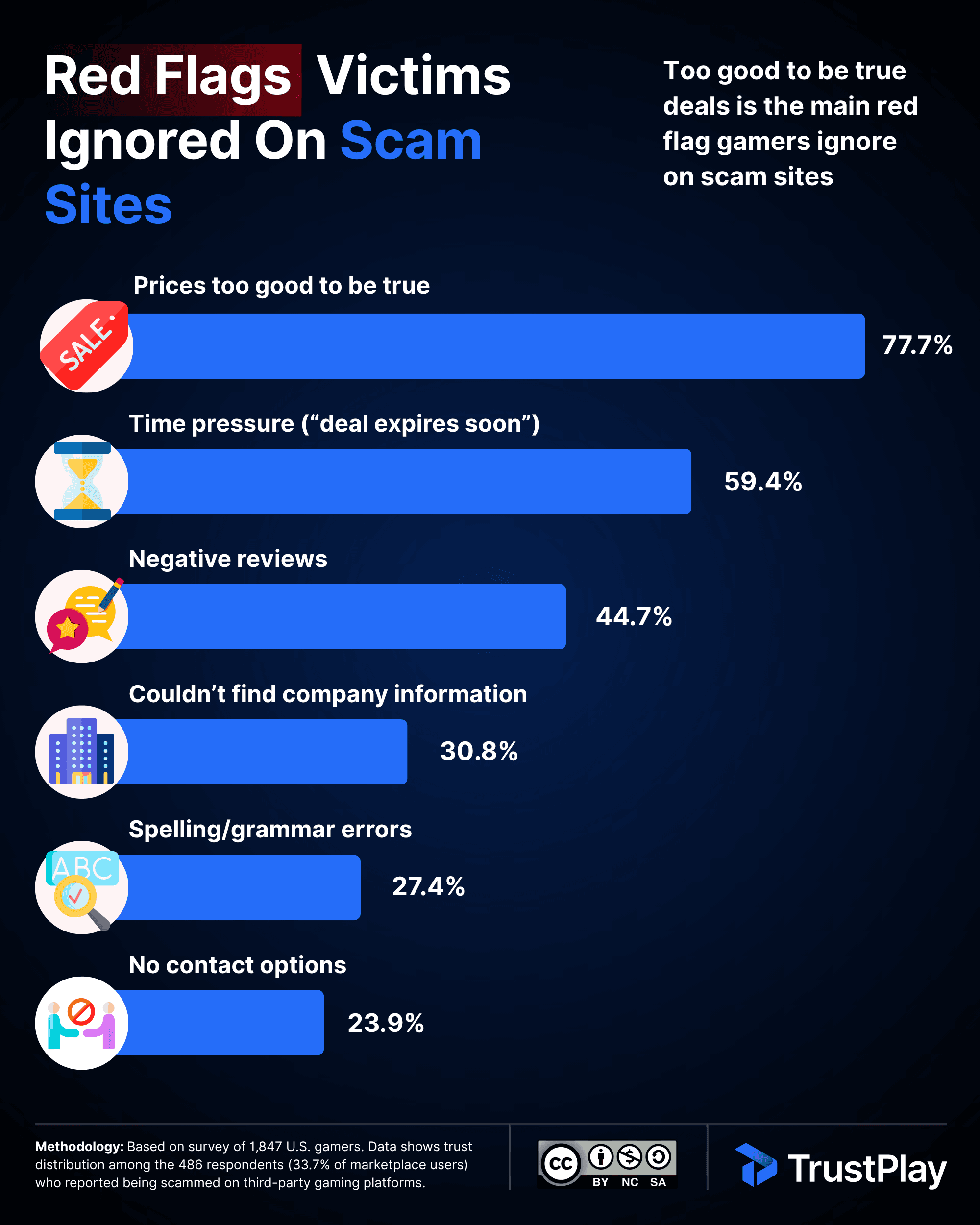
We then asked which specific red flags they ignored.
Three in four victims who saw red flags specifically noted that pricing seemed too good to be true. However, the temptation to save 30-50% or get an extra high profit from item sales pulled them in anyway.
Nearly 60% felt time pressure due to "deal expires soon!" messaging, a classic manipulation tactic that prevents due diligence.
Young Gamers Face Triple the Scam Risk
Scam rates decreased dramatically with age. Gamers under 18 experienced a 41.6% scam rate—nearly triple the 14.9% rate among players 45 and older.
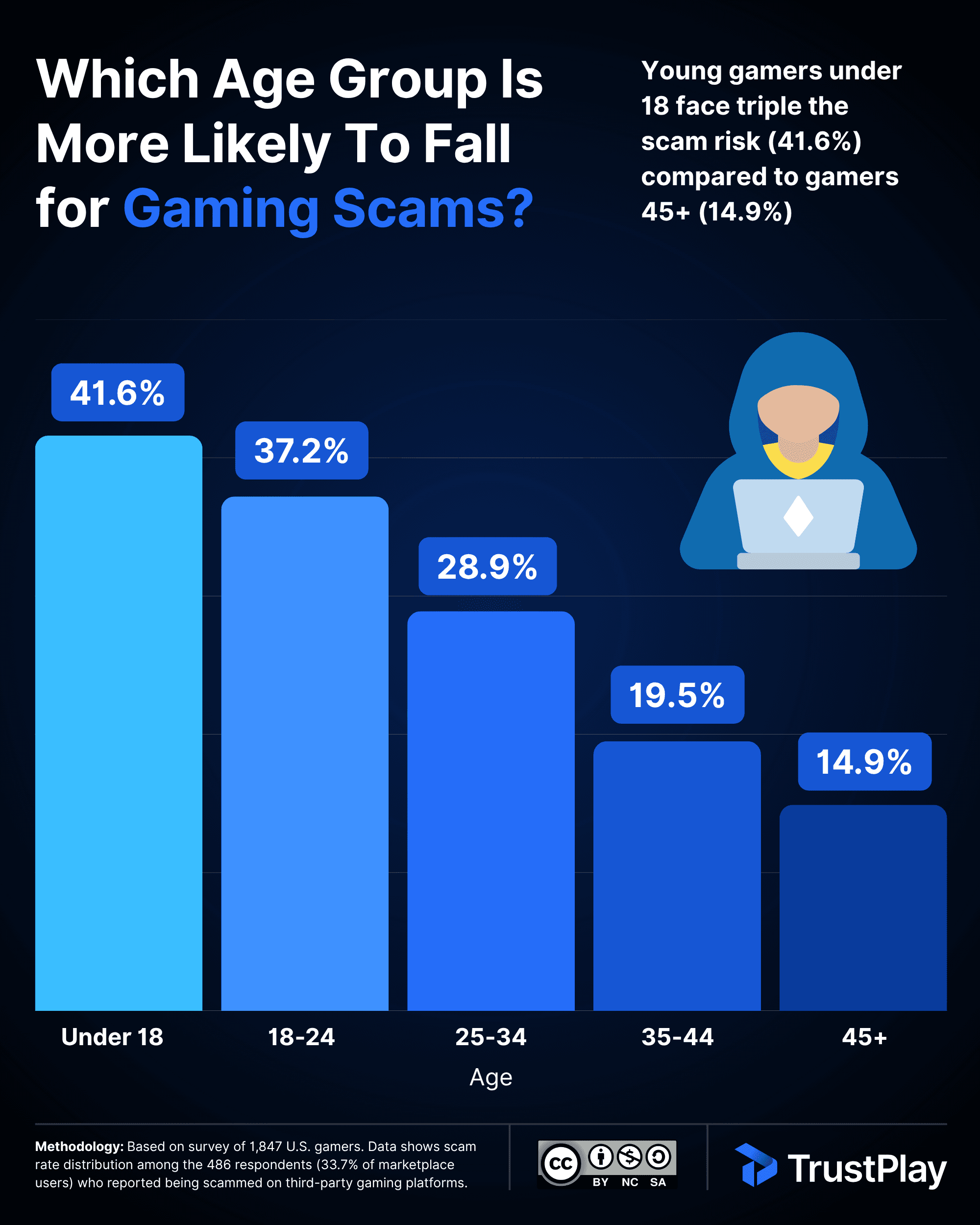
Kaspersky documented a 30% increase in cyberattacks on gamers under 18 in 2024, with 6.6 million attempted attacks. Young players generally have less experience identifying fraud, greater FOMO responses, and limited financial literacy.
Younger victims lost less per incident (median $175 for under-18s versus $425 for 35-44-year-olds), but this reflects differences in disposable income rather than scam sophistication.
Young gamers fall disproportionately for service scams (rank boosting) and account compromise, while older gamers are more likely to fall for high-value fake escrow services.
How Younger Gamers Are Scammed Differently
Under-18 players were significantly more likely to fall for:
- Service scams (28.5% vs 18.1% average): rank boosting appeals to competitive pressure
- Account compromise (22.5% vs 16.0% average): less experience spotting fake login pages
- Lower-value fake marketplaces — smaller transactions match limited budgets
Players 35+ were more likely to fall for:
- Fake escrow services (18.2% vs 8.6% average): dealing with higher-value trades
- Account purchase fraud (17.1% vs 11.3% average): buying established accounts
CS2 Players Face the Highest Risk
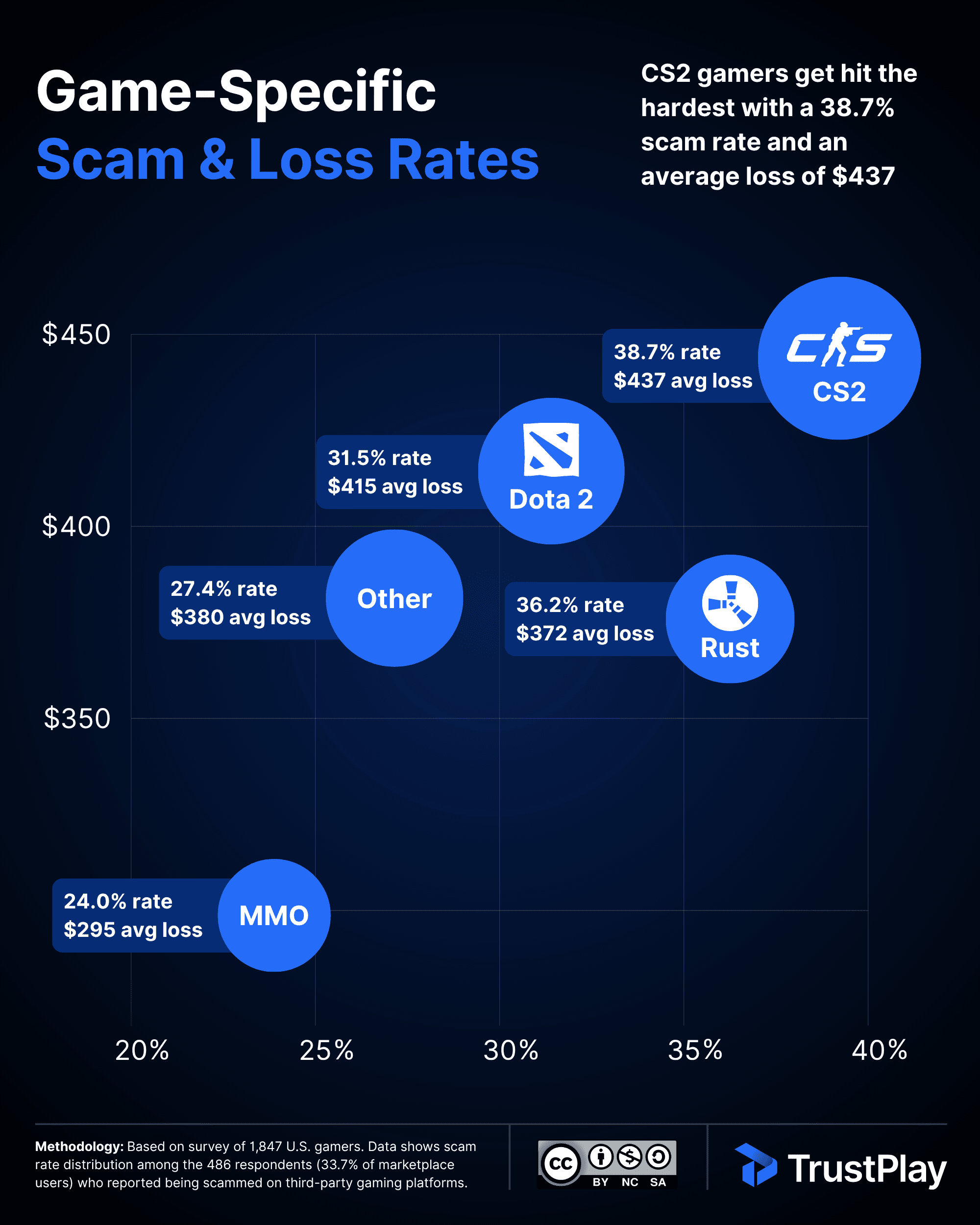
CS2 players experienced a 38.7% scam rate—significantly higher than Dota 2's 31.5% and far above MMO players' 24.0%.
The CS2 skin economy's $6+ billion valuation makes it the most lucrative target. CS2 players face more fake marketplace scams (42.6% of CS2 victims) than any other game community, reflecting the liquid, high-value nature of skin trading.
MMO players, conversely, face more service scams (29.5% of MMO victims), reflecting that game's focus on leveling services, gold selling, and account purchases rather than cosmetic item trading.
Why Most Gamers Skip Basic Safety Checks
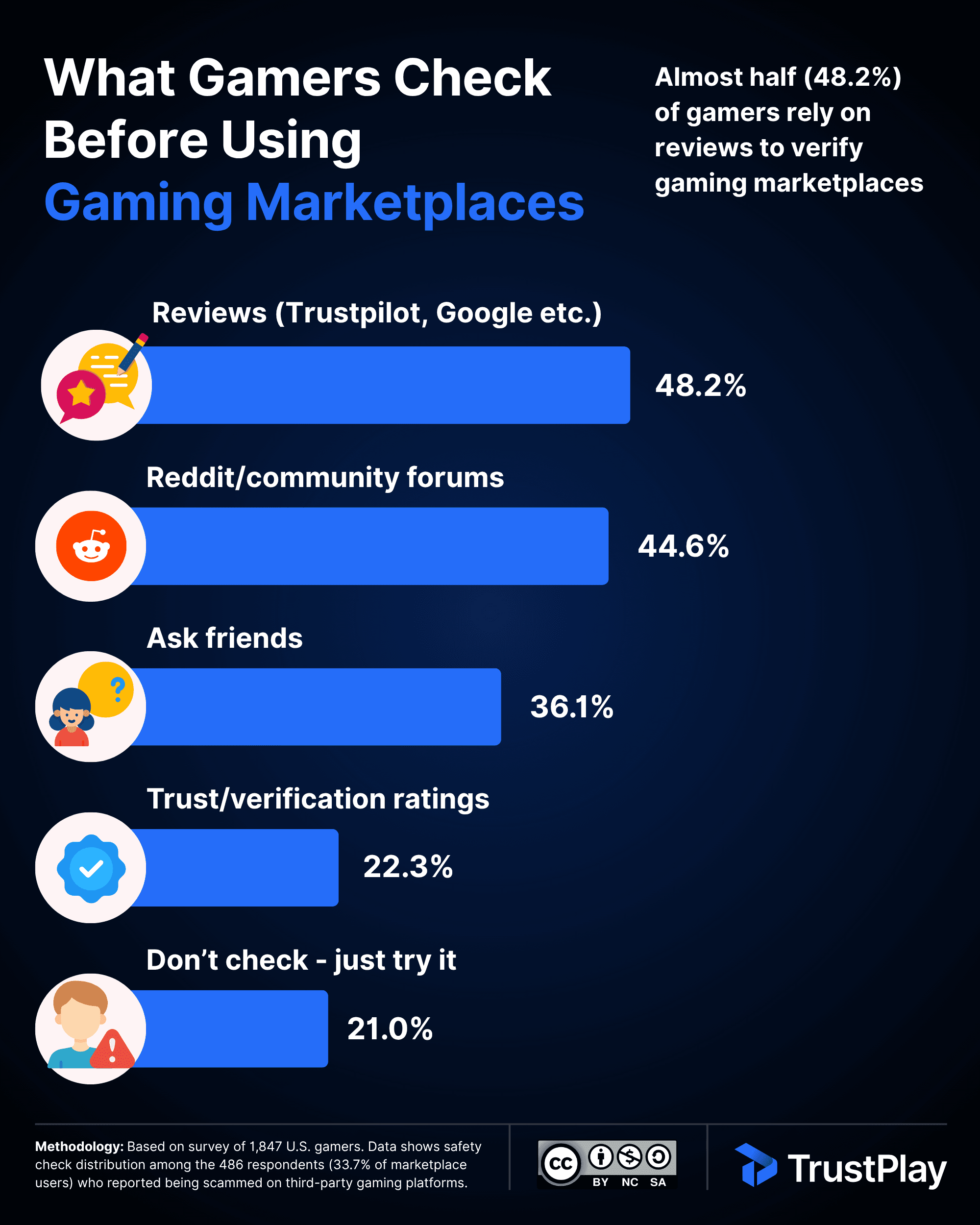
When we asked what safety measures respondents take before using marketplaces, 21% admitted they don't check anything—they just try it.
When comparing verification behaviors between victims and non-victims, the gap becomes stark:
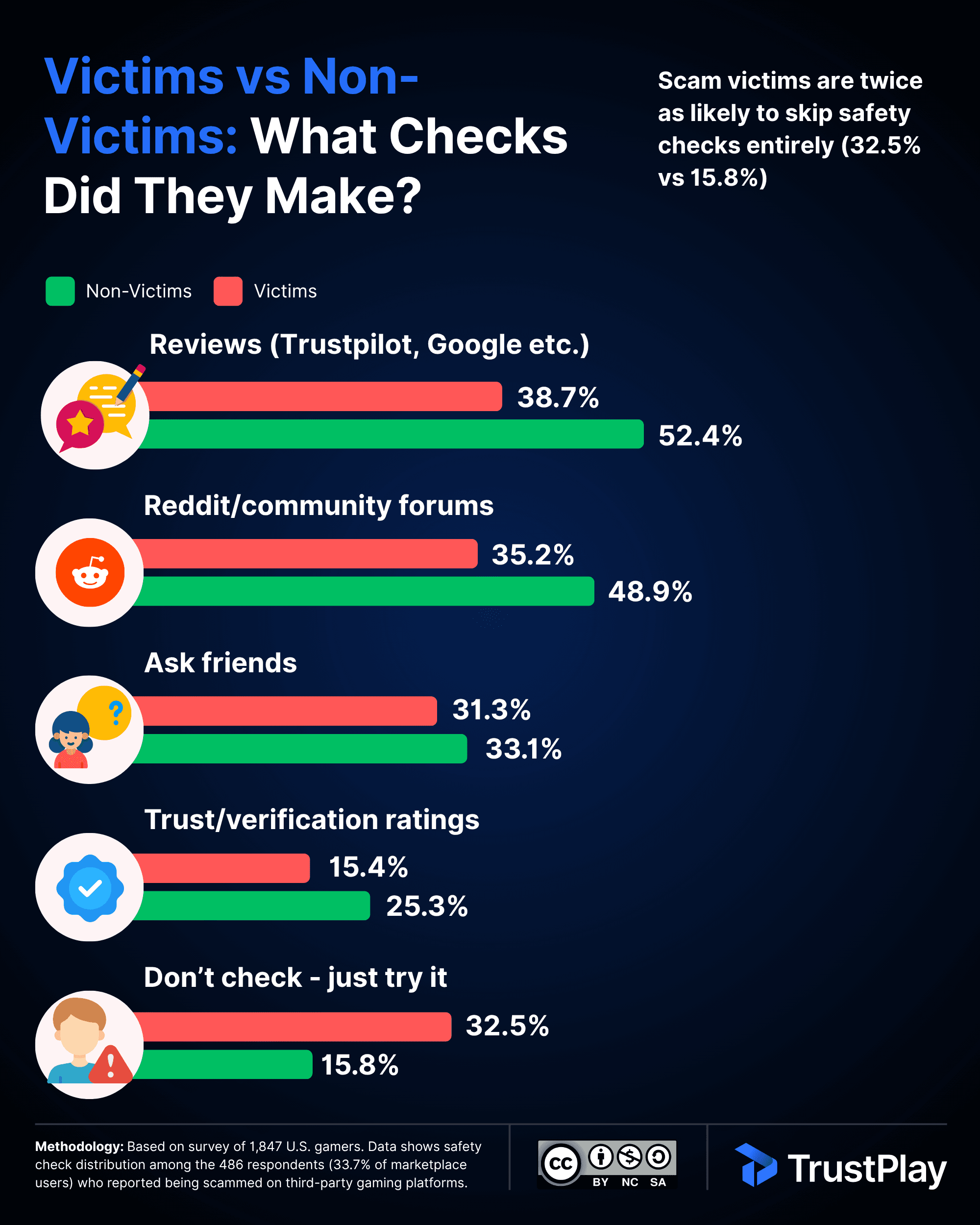
Scam victims were twice as likely to skip safety checks entirely (32.5% vs 15.8%), suggesting basic verification helps prevent significant fraud. Every verification method showed the same pattern. Victims consistently checked less than non-victims across all categories.
But even checking reviews isn't foolproof. Capital One Shopping research found that 30% of online reviews are fake or inauthentic. Scammers specifically manufacture positive reviews to appear legitimate. This explains why 63.5% of our victims said positive reviews convinced them to trust fraudulent sites.
Simple review-checking isn't enough when scammers can fabricate entire review profiles. Effective verification requires looking beyond reviews to identify fraudulent patterns—checking domain age, company registration, multiple review platforms, and whether negative reviews describe specific scam behaviors.
This reveals a fundamental truth: while platforms bear responsibility for preventing obvious fraud and providing verification tools, most scams succeed because users either skip checks entirely or rely on easily-manipulated signals like reviews.
Two-thirds of victims saw red flags but clicked anyway. One-third never checked anything at all.
The Gaps in Platform Protection
While many legitimate marketplaces offer buyer protection and solid track records, there are still significant gaps—particularly when platforms face obvious fraud or when users need basic verification tools.
When Platforms Refuse to Act on Clear Fraud
Multiple documented cases reveal Steam's policy: "All Market sales are final"—even when fraud is obvious.
In September 2024, a user reported €34.70 charged for a Dota 2 item worth €0.03—a 1,157x markup. Despite having Steam Guard enabled, Steam Support refused refunds, stating they can't take money "out of someone else's pocket."
Another victim discovered $40.03 charged for a $0.03 item (1,334x markup) while playing a different game, with no Steam Guard notification. Steam's response: marketplace sales are final.
The absence of fraud detection flagging 40x or 1,000x markups demonstrates a gap in basic security measures that could prevent obvious fraud.
The BlockBlasters Malware Scandal
In September 2025, a verified Steam game contained cryptodrain malware that stole over $150,000 from 261-907 victims. The malware was added August 30, yet the game remained available for nearly three weeks after detection.
The most publicized victim was Raivo Plavnieks, a 26-year-old streamer with stage 4 cancer, who lost $32,000 during a live charity stream for his medical treatment.
Quick Protection Checklist
- Search "[site name] + scam" before any purchase - takes 30 seconds, stops most frauds
- Never pay with gift cards, crypto, or wire transfers - these are impossible to recover
- Check domain age using WHOIS - avoid sites newer than 3 months
- Enable 2FA on all gaming and payment accounts - prevents account takeovers
- Use credit cards, not debit - fraud disputes succeed 70-90% of the time
- If scammed, dispute charges within 60 days - success rates drop sharply with time
Conclusion
One in three marketplace users experiencing scams represents a failure on multiple fronts. Users ignore red flags they see. Platforms refuse to implement fraud detection for obvious cases. The marketplace ecosystem lacks basic trust verification tools that go beyond gameable review services like Trustpilot.
The gaming industry generates $188 billion annually with 3.32 billion participants. Many legitimate marketplaces provide strong buyer protection, but the ecosystem still enables sophisticated fraud operations to thrive alongside them.
When two-thirds of victims proceed despite seeing warning signs, it shows that more education and awareness are needed; and when platforms won't flag 1,000x price markups or verify games for malware, accountability matters.
The path forward requires shared responsibility. Gamers must practice basic due diligence. Spending five minutes on verification can prevent hundreds in losses. Platforms must implement fraud detection for obvious cases and provide trust tools that users clearly want. Regulators must provide oversight matching the industry's economic scale.
The technology exists. The demand is documented. The question is whether all parties will act before the next million gamers lose $409 each.
Methodology
We surveyed 1,847 U.S. gamers between August-October 2025 via our membership base, gaming communities, Discord servers, and social media. Completion rate: 68.9%. Margin of error: ±2.3% at 95% confidence.
Sample demographics: Under 18 (9.6%), 18-24 (38.5%), 25-34 (33.7%), 35-44 (14.5%), 45+ (3.6%).
Important note: Our survey focused on active marketplace users—gamers who have used third-party trading platforms—making our sample more likely to have encountered fraud than the general gaming population. Our 33.7% scam rate reflects the lifetime experience of regular marketplace users rather than all gamers, and should be interpreted as the risk faced by those who actively participate in these ecosystems.
Research sources included Newzoo, DemandSage, Steam Charts, FBI IC3, FTC enforcement actions, TransUnion fraud reports, and Kaspersky cybersecurity research.
Data correct as of October 2025