

Two-thirds of nearly 7,000 gamers say gaming helped them cope during the hardest period of their life. Their friendships last decades. They talk about depression, grief, and breakups with people they met in-game.
That doesn't match the stereotype. Gaming still gets blamed for isolation, wasted time, and shallow relationships. So we surveyed 6,795 gamers across North America, Europe, and Asia-Pacific to find out what's actually true.
Key Findings
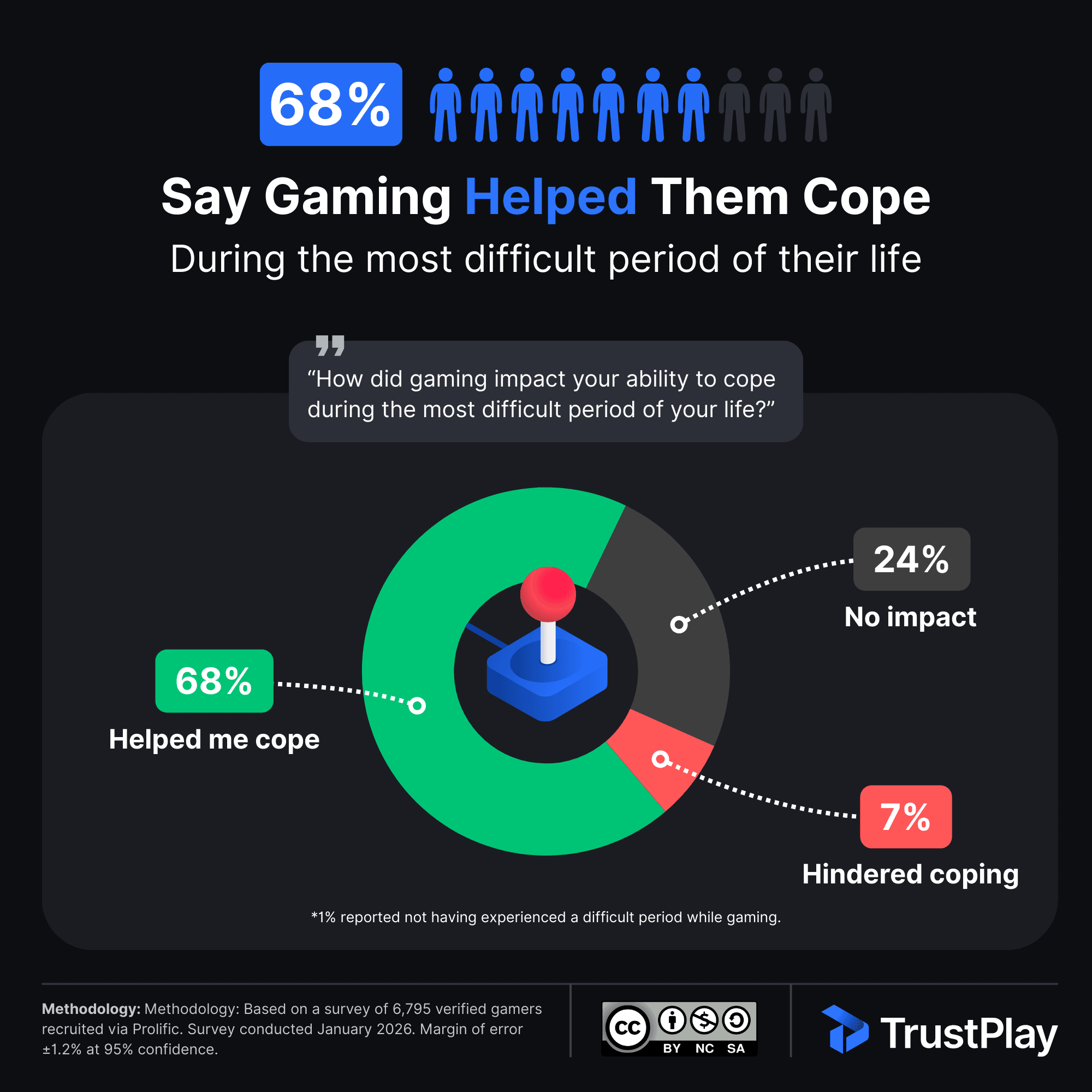
- 68% of gamers say gaming helped them cope during the most difficult period of their life
- 86% report that gaming has a positive impact on their mental health
- 46% have made at least one genuine friendship through gaming
- 77% of gaming friendships have lasted 6+ years, and nearly half exceed a decade
- 86% of those with gaming friends have discussed serious personal issues with them
- 88% of gamers who experience online toxicity still report positive mental health effects
- 75% have no regrets about their gaming time
68% Say Gaming Helped Them Through the Hardest Period of Their Life
More than two-thirds say gaming helped them through genuine hardship. And 7% acknowledged that gaming sometimes acted as a form of avoidance rather than a healthy coping mechanism. The positive findings carry more weight because the sample was willing to report negatives.
Mental Health, Grief, Loneliness: What Gamers Were Going Through
Among those who said gaming helped (n=4,590), we asked what they were facing.
| Life Challenge | % Who Said Gaming Helped |
|---|---|
| Mental health struggles (depression, anxiety) | 68% |
| Social isolation or loneliness | 44% |
| Loss of a loved one / grief | 34% |
| Job loss or career difficulties | 32% |
| Physical health issues or recovery | 30% |
| Global events (pandemic, etc.) | 30% |
| Relationship breakup or divorce | 26% |
| Family conflict | 21% |
| Financial hardship | 20% |
| Academic stress | 19% |
Mental health struggles and loneliness top the list. These are precisely the areas where gaming is most often accused of making things worse.
69% Use Gaming to Recharge, And Most Know When It Becomes Avoidance
"Escapism" gets thrown around as criticism. But there's a difference between taking a mental break to come back stronger and avoiding problems entirely.
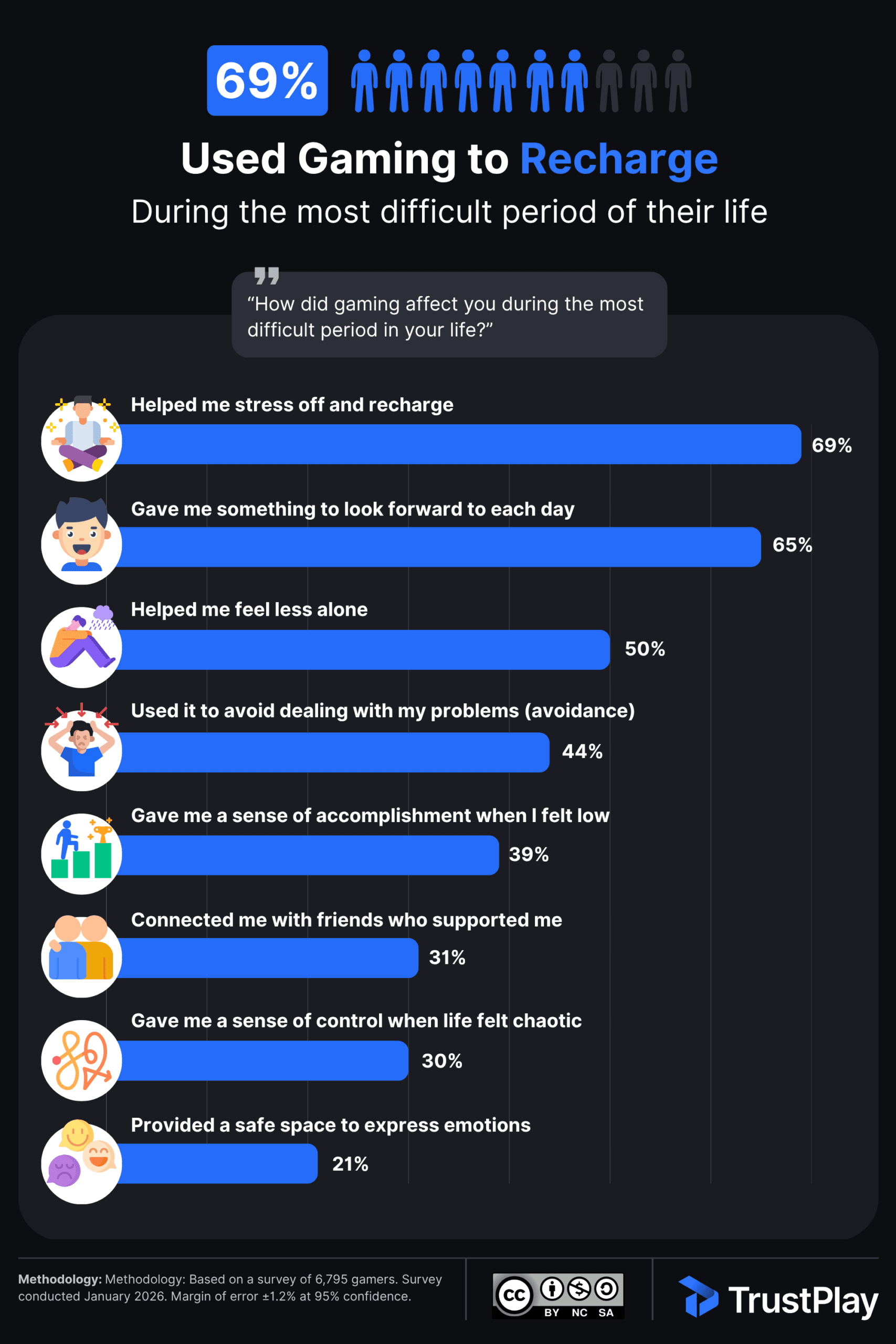
Most gamers used gaming to recharge and reset. But 44% also admitted to using it for avoidance at times, and many selected both. That overlap matters. It shows gamers can tell the difference between healthy and unhealthy use of the same activity.
86% Report Positive Mental Health Impact
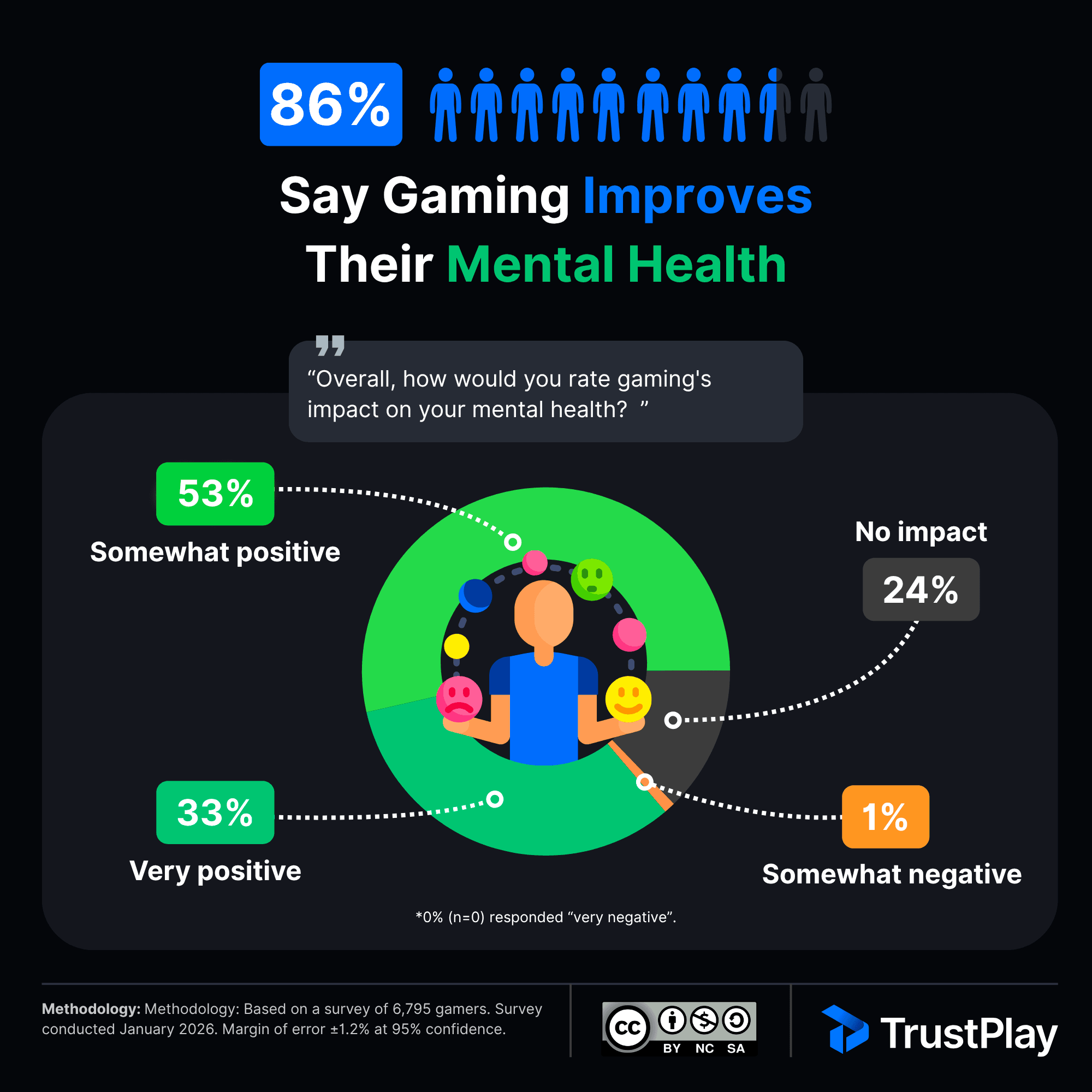
Less than 1% reported any negative effect.
These figures are consistent with broader academic findings. A University of Manchester study of 25,000 adolescents published in the Journal of Public Health found no link between gaming frequency and increased anxiety or depression.
Researchers in Japan used a natural experiment to establish a causal relationship between console gaming and improved mental wellbeing, one of the few studies to move beyond correlation.
73% Feel Better After Gaming When Stressed
We asked what typically happens after a gaming session when they're feeling stressed.
| Outcome | Percentage |
|---|---|
| I feel significantly better / recharged | 15% |
| I feel somewhat better | 58% |
| I feel distracted temporarily, but stress returns immediately | 20% |
| I feel about the same | 6% |
| I don’t play games when stressed | 1% |
Nearly three-quarters feel genuinely better after playing. Another 20% acknowledge it's a short-lived distraction rather than lasting relief, an honest self-assessment that strengthens the credibility of the positive majority.
Nearly Half of Gamers Have Made Genuine Friends Through Gaming
People still talk about gamers being lonely, but the data tells a different story.
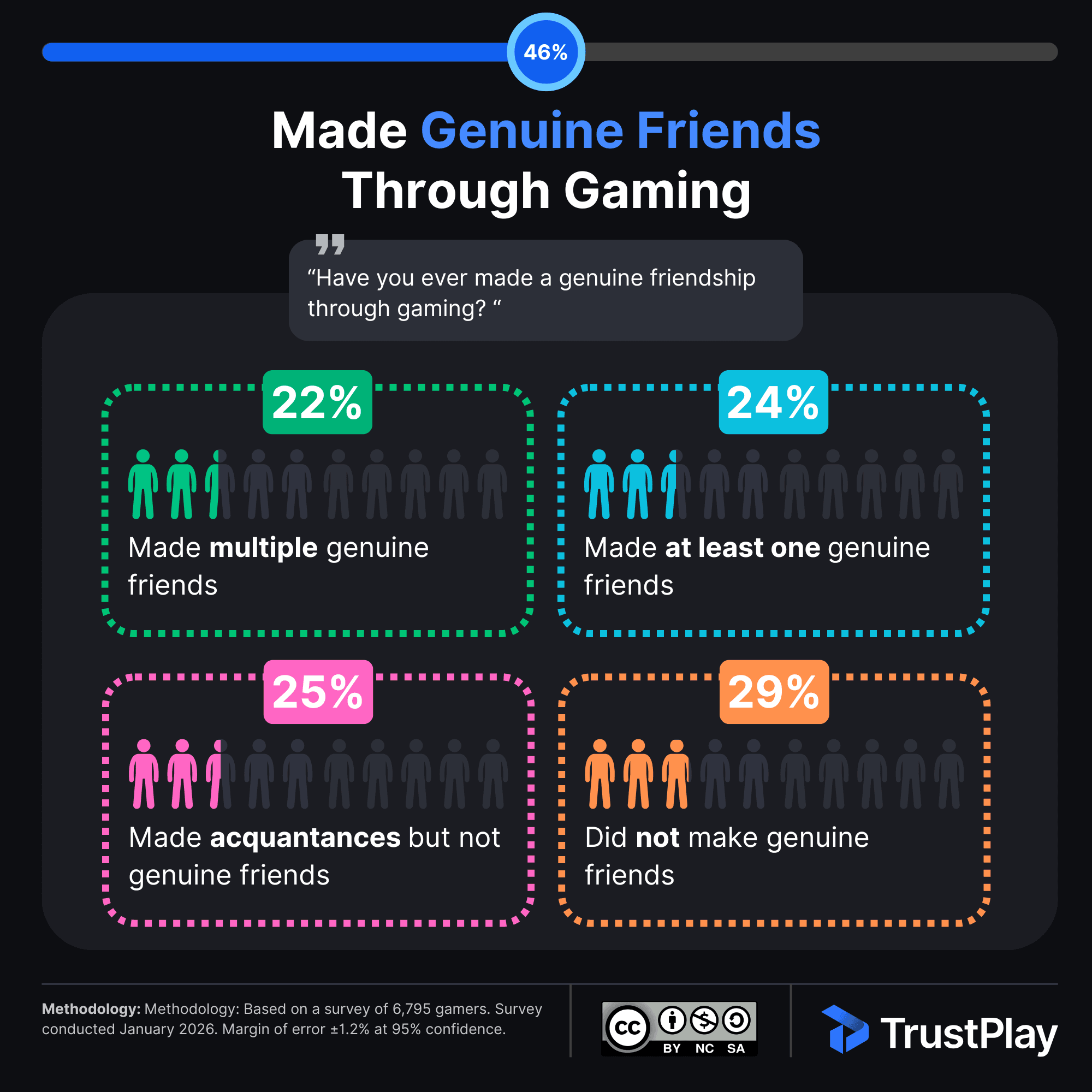
Unlike gaming-community surveys that report 80%+ friendship rates, our sample includes solo players and casual mobile gamers, making 46% arguably the more meaningful figure.
The Average Gamer Who Makes Friends Has Made 2-5
Among those who made gaming friends (n=3,105), most made between two and five.
| Number of Friends | Percentage |
|---|---|
| 1-2 friends | 39% |
| 3-5 friends | 33% |
| 6-10 friends | 15% |
| More than 10 friends | 13% |
86% Have Discussed Serious Personal Issues With Gaming Friends
Critics could argue that gaming friendships are superficial. It's just people you shoot aliens with. We tested this directly.
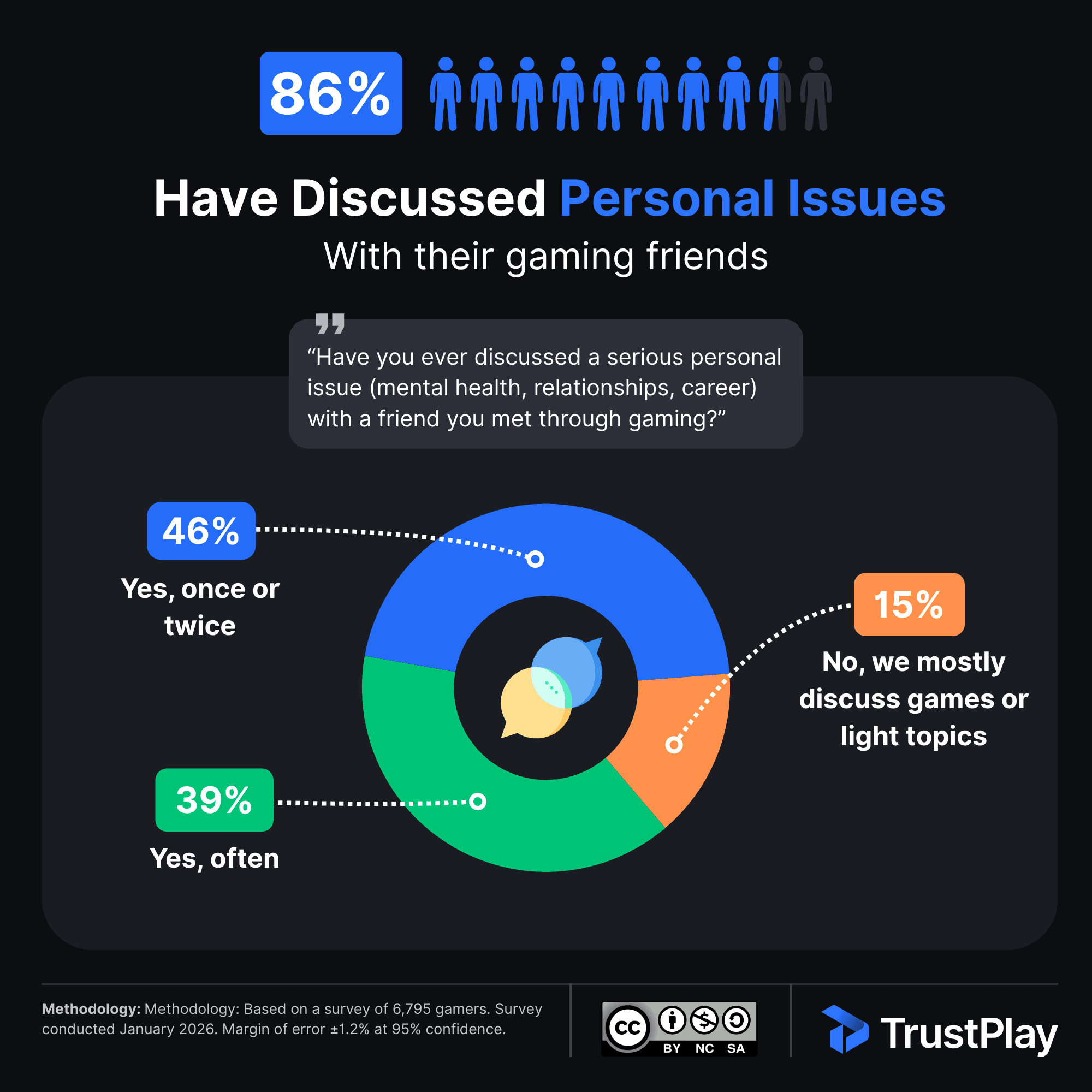
86% of gaming friendships involve discussing serious personal issues. This includes mental health, relationships, and career decisions. These aren’t just raid buddies. They’re confidants.
77% of Gaming Friendships Have Lasted 6+ Years
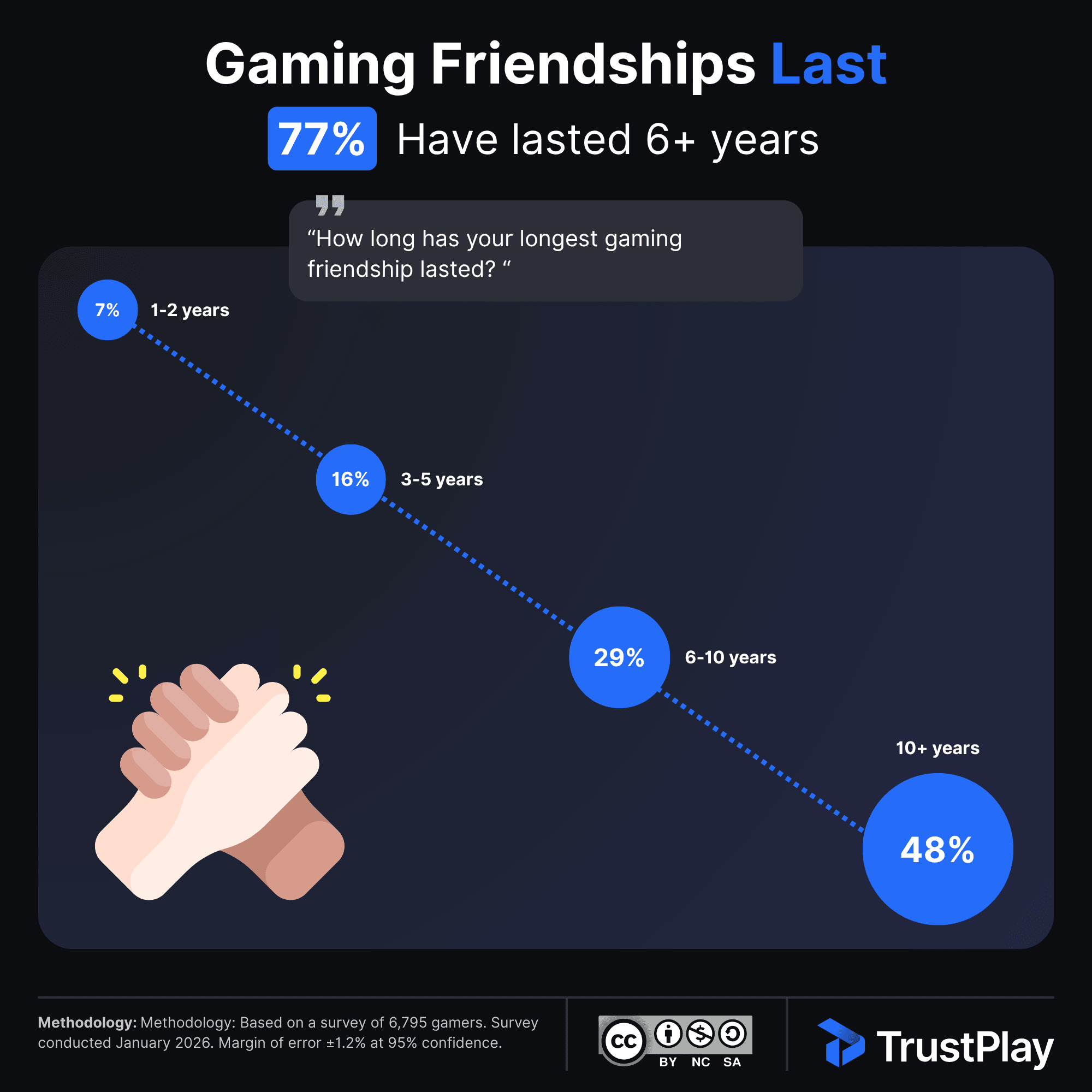
Nearly half have lasted more than a decade. Gaming creates connections that last through moves, job changes, and life transitions. These bonds aren't fleeting.
70% Have Met a Gaming Friend in Person
| Have You Met a Gaming Friend IRL? | Percentage |
|---|---|
| Yes, multiple gaming friends | 44% |
| Yes, one gaming friend | 26% |
| No, but I would like to | 22% |
| No, and I prefer to keep it online | 9% |
70% have met at least one gaming friend in person. Only 9% actively prefer keeping relationships online-only.
88% Who Experience Toxicity Still Report Positive Mental Health Effects
Gaming communities have a toxicity problem. We didn’t ignore this.
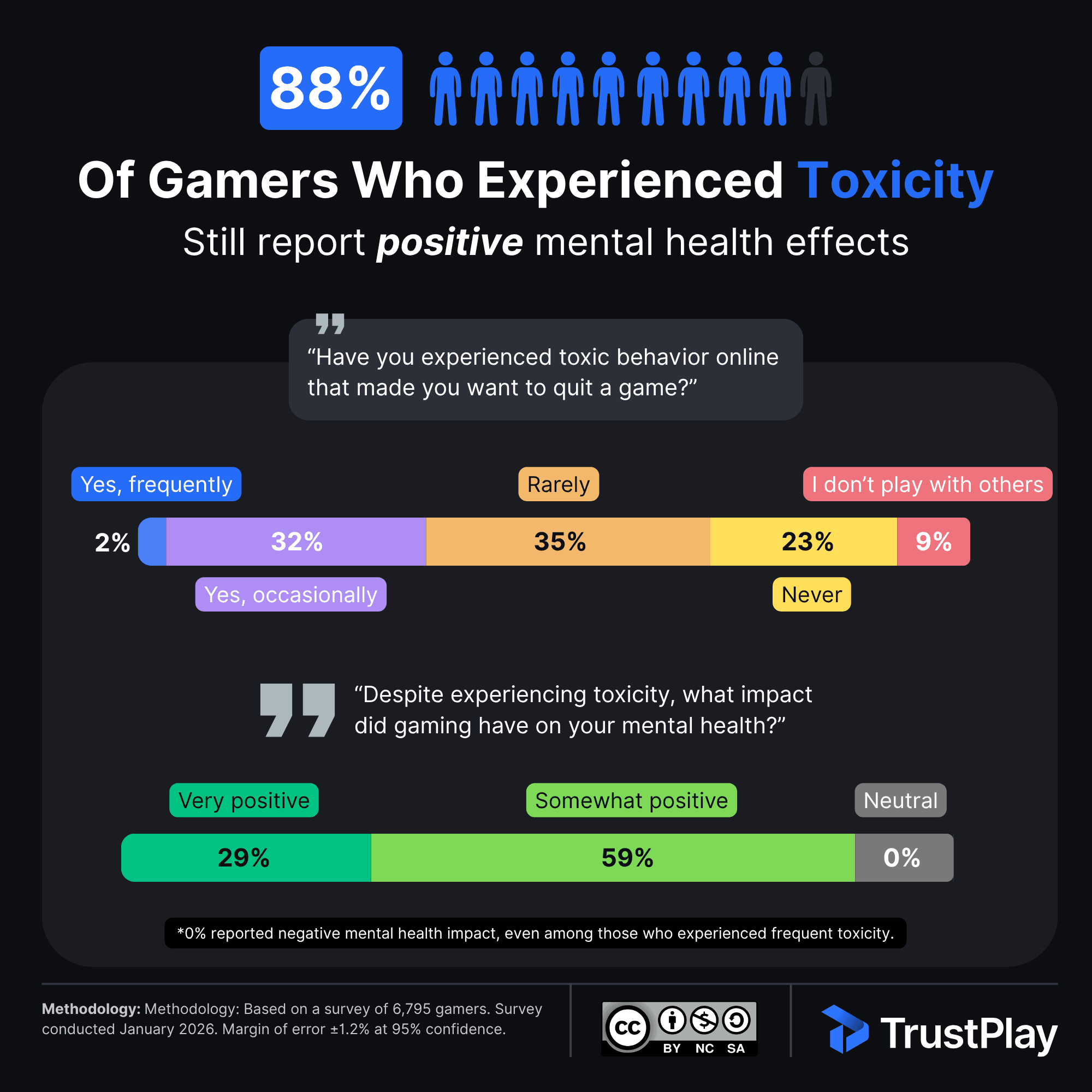
34% have experienced toxicity severe enough to consider quitting a game. That's a real problem. But among that group (n=2,295), not a single respondent reported a negative mental health effect from gaming.
38% Have Applied Gaming Skills Professionally, and Most Keep Quiet About It
| Response | Percentage |
|---|---|
| Yes, and I’ve mentioned gaming as the source | 9% |
| Yes, but I keep the gaming source to myself | 29% |
| I’m not sure if any skills transferred | 32% |
| No, the skills don’t really translate | 17% |
| No, I play specifically to disconnect from work | 14% |
More than a third have applied gaming skills professionally, from problem-solving learned in puzzle games to strategic thinking from 4X titles. For many, this quiet transfer of skills reinforces a sense that gaming time isn't wasted.
The Skills Gamers Say They've Developed
| Skill | % Who Developed It |
|---|---|
| Problem-solving and critical thinking | 65% |
| Hand-eye coordination and reaction time | 62% |
| Patience and persistence | 46% |
| Strategic planning | 35% |
| Technical skills (computers, troubleshooting) | 32% |
| Creativity | 32% |
| Teamwork and collaboration | 32% |
| Communication skills | 28% |
| Time management | 25% |
| Resource management | 24% |
| Leadership | 18% |
75% Wouldn’t Change How Much Time They’ve Spent Gaming
Instead of asking leading questions about self-improvement, we asked something more revealing.
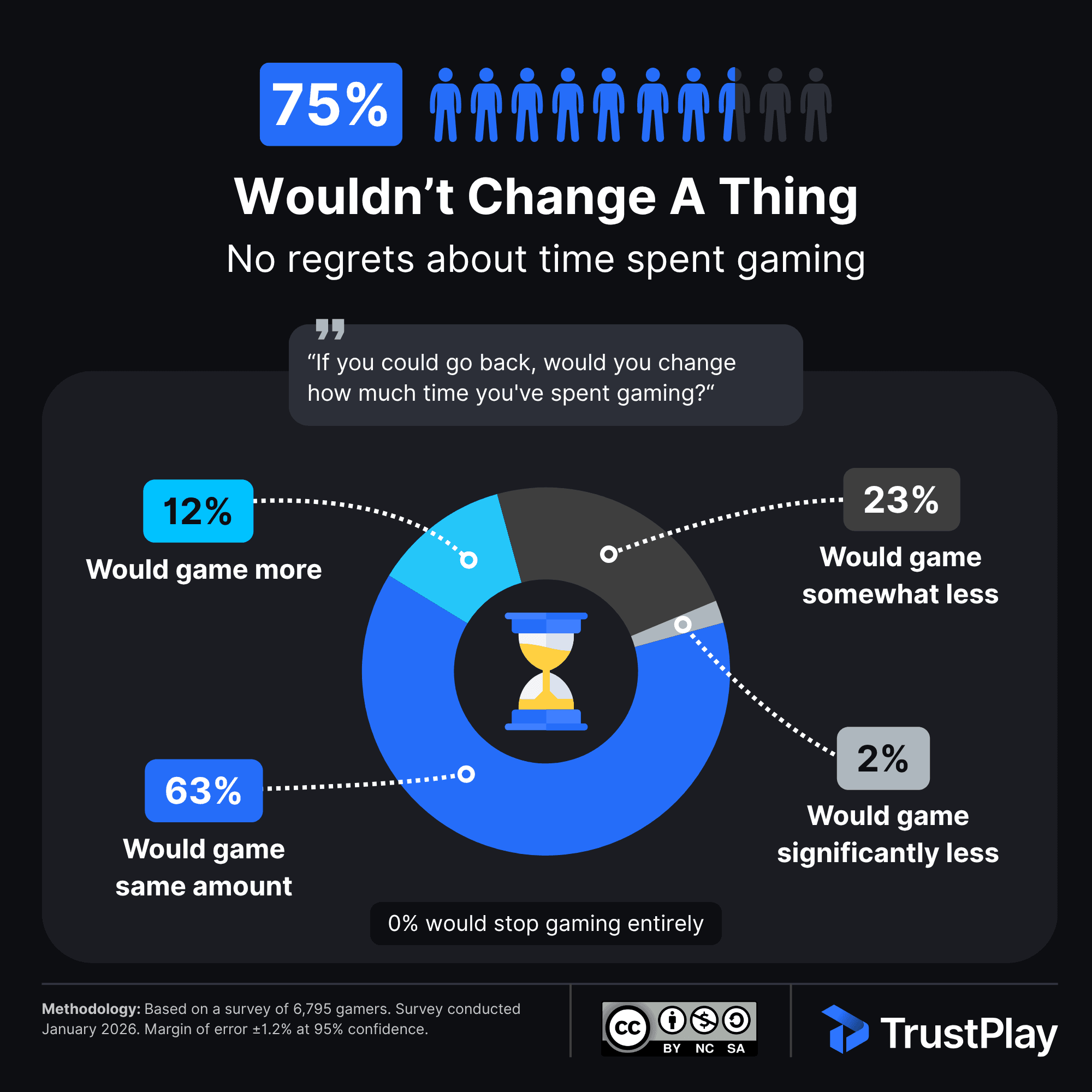
12% wish they'd gamed more. Not a single respondent would quit entirely. This isn't a population trapped by habit. These are people who've made a deliberate choice about how they spend their time and stand by it.
Gaming In One Word
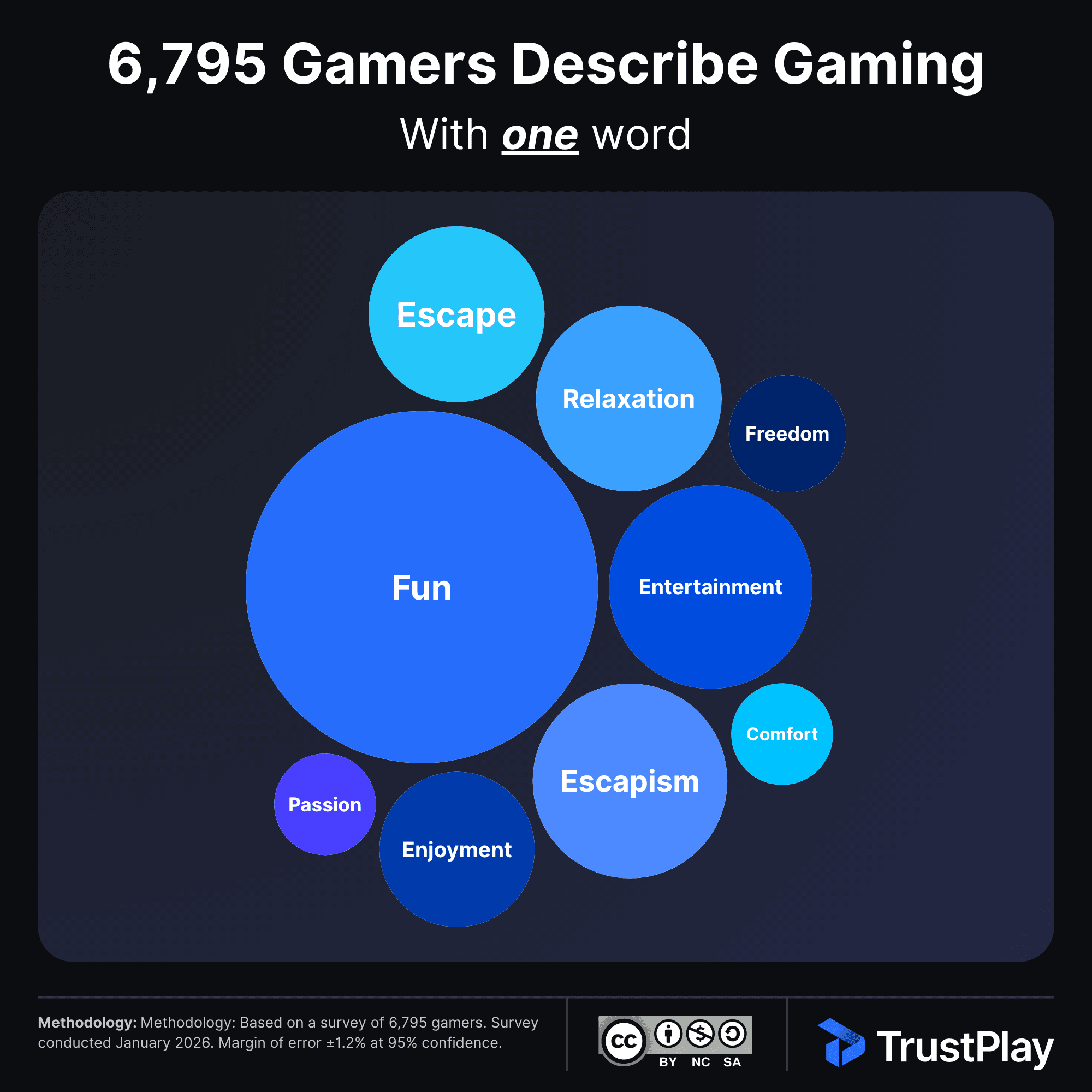
"Fun" dominated with 1,620 responses. But "escapism," "relaxation," "freedom," and "comfort" reveal something deeper. For many, gaming isn't just a pastime. It's stress relief, social connection, and even identity. It's where they breathe.
What This Means
For parents, gaming isn't inherently harmful. The key is whether it's used for recharging (healthy) or avoidance (less healthy), and gamers themselves can usually tell the difference.
For policymakers, blanket restrictions assume all screen time is equal. This data suggests it isn't. Gaming that builds friendships, provides stress relief, and helps people cope with grief is fundamentally different from passive scrolling, and policy should reflect that distinction.
For skeptics, the relationships are real. Many last decades. People discuss serious life issues with gaming friends, not just strategy. 70% have met in person.
For gamers, the benefits are real, the connections are genuine, and 75% of gamers would make the same choice again. The data backs what you already knew.
Methodology
Survey conducted: January 2026
Sample: 6,795 verified gamers recruited via Prolific research panel
Qualification criteria:
- Play video games for at least 1 hour per week.
- Age 18+
- Passed attention check questions
Distribution: United States, United Kingdom, Canada, Australia, Ireland
Languages: English
Statistical confidence: Margin of error ±1.2% at 95% confidence level
Why This Sample Matters
Unlike surveys from gaming communities, which skew toward hardcore, social gamers, our sample came from a general research panel with gaming-hobby prescreening. That means solo players, mobile gamers, and people who game just to unwind. More conservative figures, but they better represent everyday gamers.
That said, the sample is English-speaking only, so findings may not generalize globally. And like any survey, it's self-reported. Still, when 46% of this sample has made genuine friends through gaming, that's arguably more meaningful than 80%+ from a gaming Discord.
The survey included negative response options throughout ("gaming hindered my coping," "I feel more stressed after gaming") to avoid leading respondents toward positive answers. 7% acknowledged gaming sometimes impeded their coping, demonstrating the sample was willing to report negative experiences.
Why This Research?
At TrustPlay.gg, trust is what we do. That means helping gamers navigate marketplaces safely through reviews and scam protection, but it also means standing up for the truth about gaming itself.
This study is part of our pledge to accurately represent the gaming community, with data.
For media inquiries: contact@trustplay.gg
Full data tables: Available upon request
Infographics: Free to republish with attribution to TrustPlay.gg
Have a story about how gaming impacted your life? Share it with #GamerWellbeing

